The first thing Elias Vane noticed was that the horses had stopped making noise.
All evening they had been shifting in the stable behind him, stamping against the cold, leather tack creaking whenever the wind worried at the walls. Then, sometime after midnight, they had gone quiet.
That was how he knew she was close.
Animals heard fear differently from men.
Elias stood in the yard of the abandoned farmstead and listened.
Snow moved across the frozen ground in thin white snakes. Beyond the roofline, the winter fields were almost invisible, merging with a sky the colour of old iron. A line of bare poplars leaned eastward in the wind. No lamps burned in the farmhouse. No chimney smoked.
Only the barn showed a faint disturbance in the darkness.
Not light exactly.
More like the absence of complete blackness.
Elias removed one glove and touched the wooden latch.
Fresh scratches.
He looked down.
A boot print in the snow, small and narrow.
Beside it, a second mark where someone had stumbled.
He had been following those prints for eleven hours.
Before that, he had followed rumours through three villages, a coachman’s memory outside Morlaix, an innkeeper’s lie in Saint-Ronan, and the testimony of a shepherd who swore he had seen a woman crossing a frozen pasture at dusk with something bundled beneath her coat.
The woman’s name was Clara Veyne.
Twenty-six years old.
Former governess.
Possible thief.
Possible blackmailer.
Possible kidnapper.
That depended on whom one believed.
Elias believed tracks.
Tracks rarely lied.
People did.
He pushed open the barn door.
The hinges gave a low groan.
Inside, the air smelled of old hay, damp timber and animal musk. The cattle had been gone for years, but something of their warmth seemed trapped permanently in the wood.
He lit the lantern.
A weak amber circle pushed back the dark.
“Clara?”
No answer.
His breath clouded in front of him.
He stepped forward.
The hayloft above was half-collapsed. Snow had blown through gaps in the planks and dusted the floor. A broken cart rested against the far wall. Somewhere water dripped, each drop striking metal with a delicate sound that seemed absurdly loud.
Then the lantern caught movement.
Red cloth.
Elias stopped.
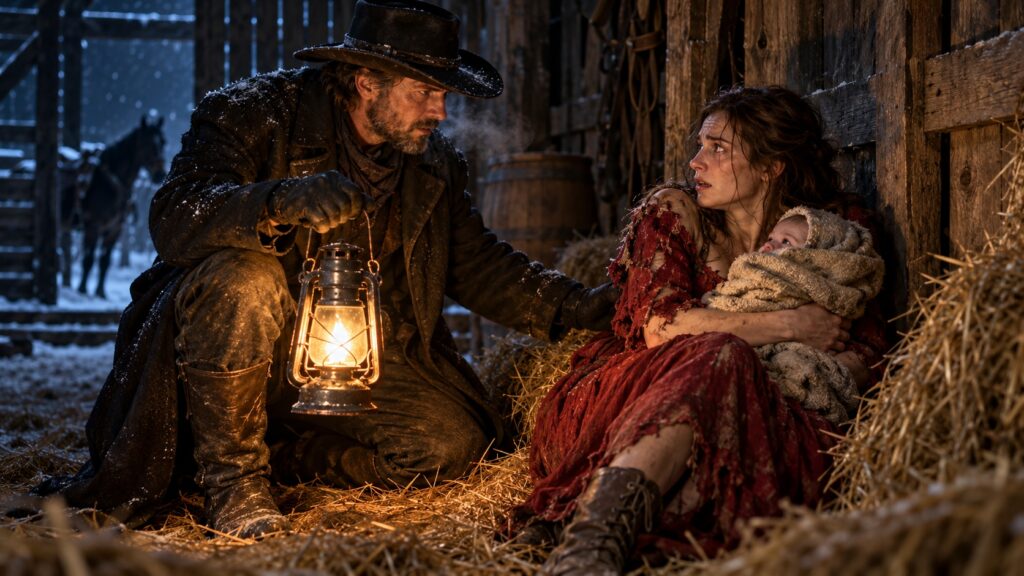
She was sitting in the corner behind a stack of hay bales, her back against the wall.
The first impression was exactly the one his employer had warned him about.
Desperate.
Disordered.
Dangerous.
Clara’s dress had once been elegant enough for a respectable household, but the hem was torn and wet, the sleeves stained from travel. Her brown boots were scraped nearly white at the toes. A loose strand of dark hair had frozen against her cheek.
She held a child against her chest.
Not held.
Shielded.
Her arms formed a cage around the infant.
Her eyes went immediately to Elias’s coat, his gloves, the knife at his belt and finally the revolver beneath the edge of his heavy wool coat.
“You found us.”
Her voice was hoarse.
Elias lowered himself slowly onto one knee.
He placed the lantern on the hay between them.
“Take it easy.”
She tightened her grip on the child.
“You’ve been in here how long?”
Clara said nothing.
“An hour?”
Nothing.
“Two?”
Her lips moved.
“I don’t know.”
“You’re freezing.”
“I know.”
“The baby is freezing too.”
At that, her face changed.
Not much.
But enough.
Fear became hostility.
“Don’t.”
Elias remained still.
“Don’t what?”
“Don’t speak about him.”
He looked at the bundle.
Only a small section of the child’s face was visible. Pale forehead. Closed eyelids. A tiny mouth.
The baby breathed.
That mattered.
“His hands warm?”
Clara looked down automatically.
Elias saw the movement and understood the answer.
“No,” he said. “They aren’t.”
She stared at him.
“You’re trying to frighten me.”
“You’re already frightened.”
“Stay away.”
“I haven’t moved.”
“Don’t take him.”
The words came quickly.
Not screamed.
That made them worse.
“Please.”
Elias watched her for several seconds.
Outside, wind struck the barn wall.
“I’m not touching the child.”
“You were sent for him.”
“Yes.”
Clara’s face emptied.
There it was.
Confirmation.
Until that moment she might still have hoped that he was some traveller, farmer, constable, anyone except the man whose arrival she had been dreading for two days.
Elias did not lie to frightened people unless the lie served some purpose.
There was no purpose in lying now.
She knew who he was.
“The old man said you were clever,” she whispered.
“What old man?”
“The innkeeper.”
Elias almost smiled.
“He also said you were ruthless.”
“That sounds more like him.”
Her eyes moved to the barn door.
Elias noticed.
“There are six kilometres of open field behind this barn,” he said. “Maybe seven. Temperature will fall again before sunrise.”
“I know.”
“You wouldn’t make the road.”
“I made it this far.”
“You had daylight then.”
“You don’t know what I had.”
“No.”
For the first time, he heard anger beneath the terror.
Good.
Anger kept people alive.
He rubbed warmth back into his bare fingers.
The contract lay folded inside his coat.
He could almost feel its weight.
Three thousand francs upon confirmation.
Another seven thousand if he returned the child alive.
An additional payment for the woman if possible.
Possible.
That was the word Lord Adrien Valcourt had used.
Not unharmed.
Not alive.
Possible.
Elias had noticed.
He noticed most things.
It was why men such as Valcourt hired him.
Three weeks earlier, Elias had sat across from the landowner in a library overlooking vineyards buried under winter rain.
Valcourt had been fifty-eight, silver-haired, composed and dressed with the quiet extravagance of men who considered wealth a natural law.
“My son’s child was taken,” he had said.
“By whom?”
“A woman who worked in the household.”
“The mother?”
A silence had followed.
“No.”
Elias had looked up.
Valcourt’s expression had remained perfectly calm.
“She is unstable.”
“That wasn’t my question.”
Valcourt had poured wine.
“My son made mistakes.”
“What sort?”
“The ordinary sort.”
Elias had not touched the wine.
“Ordinary mistakes usually don’t require a tracker.”
The older man smiled.
“I was told you were discreet.”
“I was told you paid well.”
That ended the questions.
Or seemed to.
Now, kneeling in the barn, Elias wondered why the memory had returned with such clarity.
Perhaps because of the way Clara held the child.
Perhaps because he had seen women who had stolen infants.
He had once tracked a woman across the Austrian border after she took her sister’s newborn during a period of grief.
That woman had held the child like evidence of something owed to her.
Clara held this baby as if every bone in her body existed for one purpose.
To place herself between the child and everyone else.
Elias picked up the lantern.
Clara flinched.
“I’m checking his face.”
“No.”
“He needs heat.”
“I said no.”
“He may already be hypothermic.”
The word frightened her more than the gun.
Her eyes filled, but she did not cry.
Instead she looked down at the infant.
Elias saw the decision forming.
She hated him.
She needed him.
There were few positions more dangerous than that.
“Let me see one hand,” he said.
Clara hesitated.
Then slowly adjusted the blanket.
That was when Elias saw the embroidery.
A silver stag beneath a crown.
Small.
Precise.
Sewn into the linen with pale grey thread.
He knew the symbol.
Everyone in western Bretagne knew it.
The Valcourt crest.
Elias had seen it on wine crates, carriage doors, estate documents, even the brass buttons worn by the servants in the manor.
Clara saw him looking.