Chapter Four – A History of Leaving
There had always been departures between them.
Small ones first.
A train missed by minutes.
A weekend postponed.
A door closed too hard after an argument.
Then larger ones.
Cities.
Promises.
Years.
Perhaps their entire relationship had been shaped by the fear that one of them would leave before the other was ready.
The young woman finished tightening the bandage again and withdrew her hands slowly.
He seemed to feel the absence immediately.
“So,” she said, “you fixed it?”
“What?”
“The family problem.”
He looked toward the foliage.
“Some of it.”
“That sounds like another way of saying no.”
“It became complicated.”
“Everything becomes complicated when people refuse to speak plainly.”
He glanced at her.
“That sounds directed at me.”
“It is.”
A reluctant smile appeared.
She hated that she still knew how to produce it.
The young man stood carefully.
He tested his arm.
She rose too.
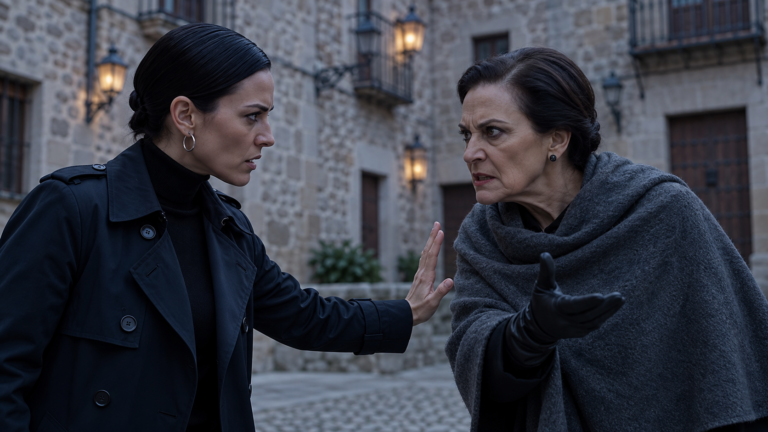
For a moment they faced each other beneath the trees.
Neither had anticipated how different standing would feel after sitting close together.
The distance became visible again.
He was taller than she remembered.
Or perhaps memory had reduced him.
She folded her arms.
“You still haven’t explained why you’re here.”
“Neither have you.”
“I asked first.”
“That argument used to work when we were twenty.”
“It still works.”
He looked toward the path hidden between the vegetation.
“I needed somewhere quiet.”
She raised an eyebrow.
“That is a suspiciously ordinary answer.”
“It’s also true.”
“Why today?”
His expression changed.
Subtly.
She noticed.
There it was again: the fraction of hesitation before concealment.
He had not lost the habit.
But this time she did not accuse him.
Instead she said, “You received something.”
His eyes narrowed.
“What makes you think that?”
“You touched your pocket.”
He looked down automatically.
She almost smiled.
“You’re still terrible at hiding things.”
He reached into the inside pocket of his black top and removed nothing.
He merely pressed his palm against the fabric.
“A letter,” she guessed.
His eyes lifted.
She knew she was right.
“From whom?”
He hesitated.
“My mother.”
Something in her face softened.
She remembered meeting his mother once.
A beautiful woman in a grey dress who had looked at her with polite warmth and unmistakable fear.
At the time, the young woman had believed she disapproved of their relationship.
Years later she wondered whether the older woman had simply known how easily love became collateral damage in a family accustomed to secrecy.
“What did she say?”
“That she was sorry.”
“For what?”
“Almost everything.”
The answer carried no bitterness.
That made it worse.
He looked away.
“She kept records. Letters. Documents. Things I thought had been destroyed.”
“And she sent them to you?”
“She died two months ago.”
The young woman became still.
He had spoken the sentence with such control that for a moment it did not seem real.
Then she saw the grief in the way his fingers curled.
“I didn’t know.”
“No.”
“You could have told me.”
He gave a quiet laugh.
“We weren’t speaking.”
“You could still have told me.”
He looked at her.
The implication hung between them.
There were some people one continued imagining in moments of loss even after they no longer belonged to one’s life.
She had been that person for him.
He had been that person for her.
“I almost called,” he said.
“When?”
“The night she died.”
Her breath caught.
“Why didn’t you?”
“I didn’t know whether hearing my voice would hurt you.”
“And you decided for me again.”
“Yes.”
The admission was almost whispered.
She looked toward the trees.
For several moments she could not speak.
She had spent years believing he had forgotten her.
The possibility that he had remembered too much was harder to process.
“Was the letter about me?” she asked.
He did not answer immediately.
That told her enough.
She turned back to him.
“What did she write?”
He touched the pocket again.
“She said she had asked me to leave.”
The forest seemed to narrow around them.
She stared.
“What?”
He closed his eyes briefly.
“She was afraid.”
“Of me?”
“Of what would happen if you became involved.”
The young woman felt anger rise, old and immediate.
“You told me it was your decision.”
“It was.”
“Was it?”
“Yes. She asked. I agreed.”
“Why?”
“Because at the time I thought she was right.”
The words cut more deeply than she expected.
He stepped closer.
“Not about you.”
She looked at him.
“About me.”
He continued quietly.
“She said I had inherited the worst habit in our family. That I confused love with rescue. That if I stayed with you while everything was collapsing, I would turn you into another person responsible for saving me.”
The young woman said nothing.
“She believed I would need you too much.”
“And what did you believe?”
He met her gaze.
“That she was right.”
A silence followed.
Then she asked the only question that mattered.
“Were you?”
He looked at her for a long time.
“Yes.”
The answer was not dramatic.
It did not need to be.
His honesty entered the space between them with frightening gentleness.
She realised then that the past had not returned merely to accuse them.
It had returned to ask whether they were still the people who had destroyed what they loved.